There has been a great deal of discussion about California’s new Zone 0 wildfire regulations — and, as often happens, some rather alarming claims on social media about what homeowners will be required to do.
So what does Zone 0 actually mean for those of us living in Rancho Cielo?
This week, the California Board of Forestry and Fire Protection finalized the Zone 0 regulatory package establishing an ember-resistant zone within the first five feet surrounding homes and other structures in the state’s highest fire-risk areas.
After months of personally following this issue and reading the documents as they developed, I thought it might be helpful to share a simple homeowner’s overview of the final rules — and perhaps clear up some misconceptions along the way. This is my personal reading and understanding of the regulations, not a legal interpretation. I encourage everyone interested in the details to read the State Board’s documents for themselves.
We live in an area with significant wildfire exposure. We also have outstanding professionals at the Orange County Fire Authority who work continuously to prepare for and respond to that risk. OCFA will even visit your property and provide guidance at no cost.
There are also things we can do to help them protect our homes.
It’s All About the Embers
When most of us picture a wildfire threatening our neighborhood, we imagine flames coming over the hill.
But one of the greatest threats to homes comes from wind-driven embers.
Embers can travel far ahead of the actual fire. They land around our homes, collect in vulnerable locations, and can ignite leaves, mulch, wood or other combustible materials. A very small fire next to a house can become a very large problem.
We can’t prevent embers from arriving.
What we can do is reduce the opportunities they have to start a fire when they get here.
That is the basic idea behind Zone 0.
No, You Don’t Have to Give Up Your Beautiful Green Yard
This may be the biggest misconception I’ve seen.
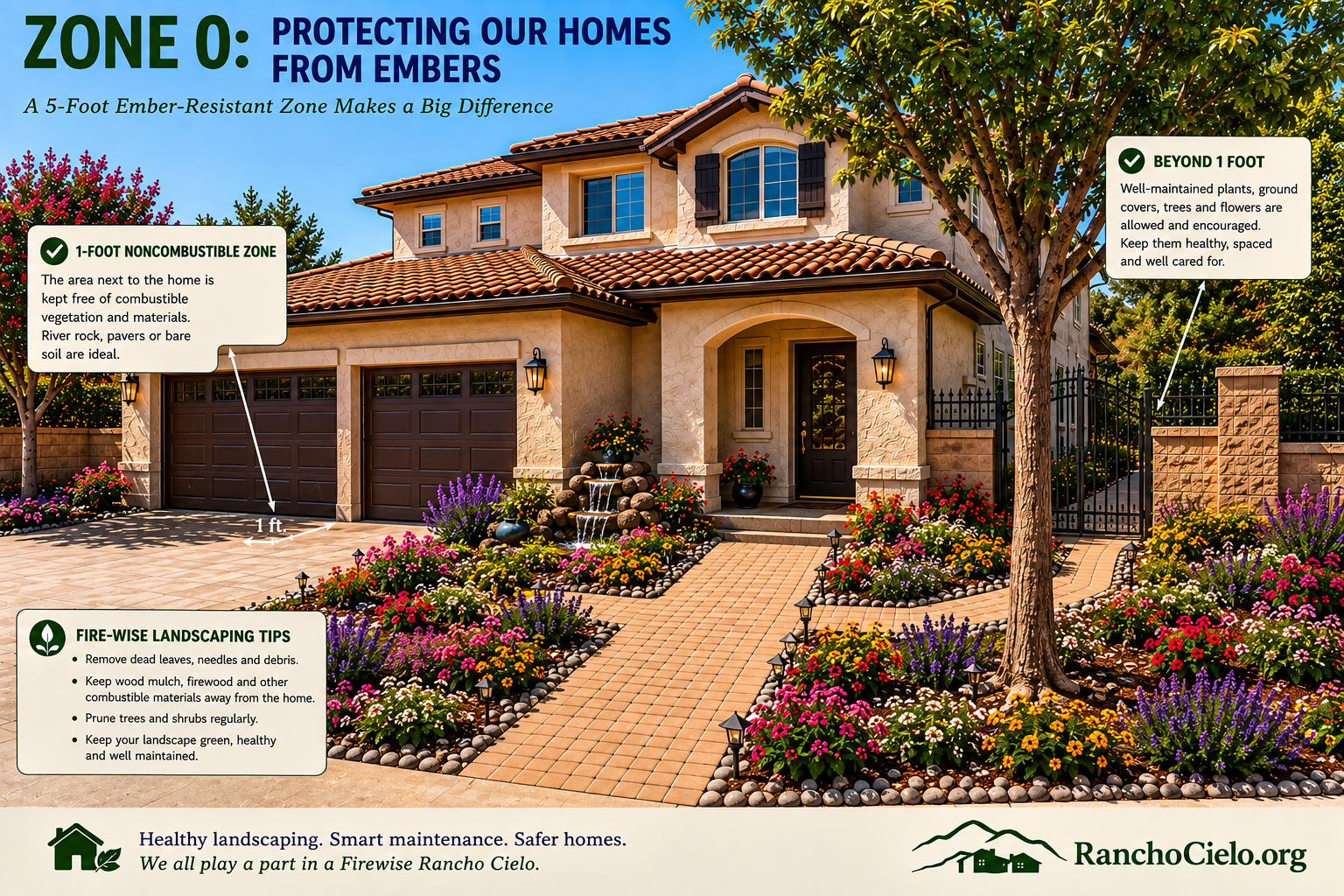
Zone 0 does not require homeowners to eliminate all landscaping within five feet of their homes and replace it with a barren strip of concrete or gravel.
The regulations actually allow a variety of well-maintained vegetation within portions of Zone 0.
Existing mature trees can remain, provided they are properly maintained. Dead wood and ladder fuels must be removed and branches appropriately separated from roofs, chimneys and other vulnerable areas.
Outside the immediate safety areas, the regulations also allow properly maintained lawns and low ground covers, along with many non-woody plants and flowers. Examples specifically mentioned by the CA State Board include bulbs, impatiens, begonias, petunias, poppies, yarrow and certain succulents.
So the objective isn’t to eliminate attractive landscaping.
It’s to separate combustible fuels from the places where an ember-created flame could ignite the house.
And Existing Homeowners Have Time
Another important point is that the regulations are designed to be phased in.
For existing homes, the CA State Board has provided two phases extending over as much as five years.
During the first three years, the emphasis is primarily on removing combustible materials within five feet of the structure — things such as wood mulch, wood chips, firewood, fallen leaves and dead vegetation — along with appropriate tree maintenance and adjustments to landscaping.
A second phase, completed on a schedule established locally within five years, addresses the immediate safety zone beneath eaves and certain changes involving gates, fences and sheds.
Some existing requirements involving dead wood, roof and gutter debris, and branches near chimneys would take effect sooner.
In fact, the CA State Board’s own documents repeatedly emphasize education, assistance and measurable progress over time.
Of course, we don’t have to wait five years to make simple changes that make sense for our homes.
The Immediate Noncombustible “Safety Zone”
Within Zone 0 is a smaller area immediately adjacent to the house where the rules become more restrictive.
Think of this as the place where we especially don’t want an ember to find something capable of producing a flame against the house.
The safety zone extends at least one foot from the structure, or to the edge of the eave above it — whichever is greater.
There are additional vegetation-free areas around particularly vulnerable locations, including windows, doors, vents, attached decks and similar features.
For many Rancho Cielo homes with relatively modest eaves, this may translate into a fairly narrow strip along much of the house.
This area should contain no combustible vegetation or materials.
That makes intuitive sense when you look closely at our homes. One particularly vulnerable location can be the area at the bottom of an exterior wall where the stucco assembly meets the foundation. We don’t want burning mulch, leaves or vegetation creating flames immediately against that area.
The goal is simple:
Don’t give an ember the fuel it needs to create a flame against the house.
The Rest of the Five Feet
From the immediate safety area outward to the five-foot boundary, the rules are considerably more flexible.
This is described as the low-combustibility zone.
Properly maintained herbaceous plants and flowers can remain here. So can low ground covers and maintained lawn. Certain small potted plants in noncombustible containers are also permitted.
Existing trees may remain in Zone 0 with appropriate maintenance.
What should disappear are the things most likely to readily ignite and carry a flame: accumulated leaves and needles, dead vegetation, wood chips and combustible mulch, firewood, stored lumber and similar materials.
In other words, green and maintained is very different from dead, dry and combustible.
Fences, Gates and Sheds Matter Too
There are a few other provisions worth knowing about.
Where a combustible fence or gate connects directly to a house, the regulations call for a five-foot noncombustible section. An example would be replacing the portion immediately adjoining the house — or a wooden gate — with a noncombustible alternative.
Small sheds and outbuildings located within Zone 0 also have requirements involving noncombustible exterior walls and roofs.
Again, these provisions for existing homes are part of the longer phase-in period.
This Isn’t About Panic — It’s About Understanding the Risk
I think this is the most important takeaway.
There is no reason to panic, tear out a healthy landscape, or begin making expensive changes because of something you read on Facebook.
Take some time instead to look at the first five feet surrounding your home.
Where could leaves accumulate?
Is there wood mulch against the house?
Are there dead branches or dry vegetation?
Could an ember land somewhere and ignite something that would produce flames against the structure?
Those are useful questions regardless of when the various requirements are implemented.
We are fortunate to live in a beautiful community next to open wildland. That brings some risk with it, but we also have excellent firefighting resources and access to more information than ever before about how homes ignite during wildfires.
We don’t need to eliminate that risk — because we can’t.
We can simply continue learning and make reasonable improvements that reduce it.
That’s what being a Firewise community is really about.
Read the Actual Regulations
Don’t rely solely on my summary — or anyone else’s.
The California Board of Forestry and Fire Protection has published the Zone 0 regulatory package along with illustrations showing what compliant homes and landscaping can actually look like.
I particularly recommend looking at the illustrations. They make it much easier to understand how the rules can apply to an attractive, normally landscaped home.
Read the California Board of Forestry and Fire Protection Zone 0 regulatory package.
New Zone 0 Regulations
New Zone 0 Regulations
New Zone 0 Regulations
Leave a Reply
You must be logged in to post a comment.